
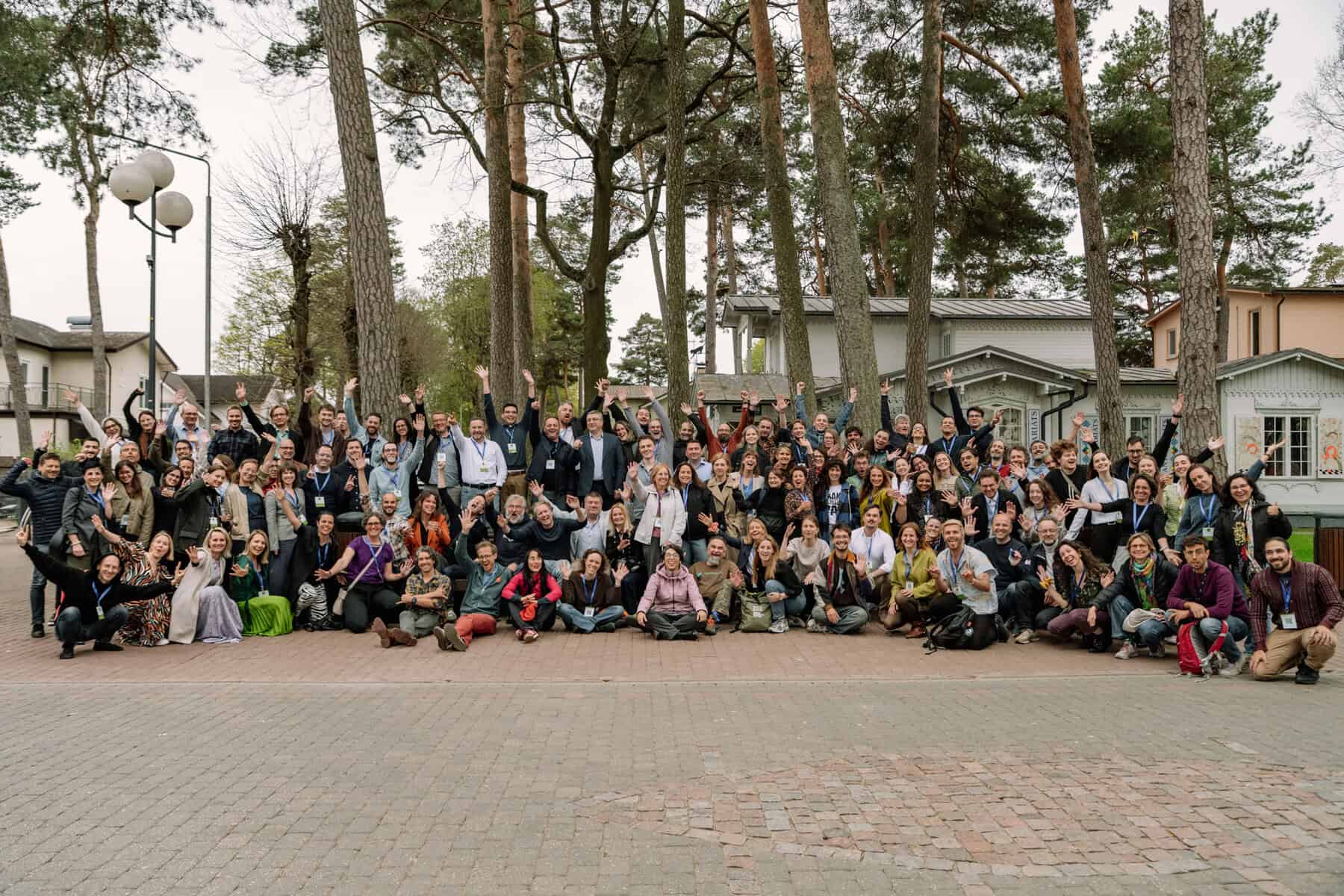
Labrīt! Reporting back to you from our visit to Jūrmala for the European Energy Communities Forum organised by Rescoop at the beginning of May!
Taking place in Jūrmala, Latvia, on their 35th Year Anniversary of Independence, the event brought together community energy groups (known locally as ‘energy communities’), federations, researchers, and think tanks to collectively learn from each other’s experiences of driving forward locally owned clean energy from across the continent. The Forum was the perfect opportunity for us to hear more about the staggering range of projects developing across Europe, share insights from here in the UK, and strengthen bonds with our European neighbours.
The Forum also came off the back of the recently launched EU Citizens Energy Package, which launched in April in response to energy shocks caused by the US and Israel’s attack on Iran, and Russia’s ongoing war in Ukraine. The package is designed to accelerate the transition to affordable, low-carbon energy, with tangible benefits for households, communities, and small businesses across the EU.
Spread across three days, the Forum’s agenda covered a wide range of topics, including finances and funding opportunities, flexibility markets, heat networks, communications, and social impact. We were invited to speak at the latter session, organised by the Thessaloniki arm of the Heinrich Böll Foundation, a green-aligned think tank that promotes sustainability and democratic participation worldwide. During this session, we were one of five organisations to present our approach to creating and measuring socially impactful outcomes. We showcased our previous work trialling the Social Value Portal to measure the social return on investment of community energy, and our subsequent pivot to our current research project in collaboration with the Universities of Sheffield, Bristol, and Oxford. This research project generated great interest, and an eagerness among participants to ensure that our recommendations for improving the ways CE groups record their impact are replicable across Europe. From our fellow presenters, we learned about innovative toolkits to measure impact, strategies to make membership accessible to fuel-poor households, and social tariffs that make the most of energy sharing and local supply.
Local supply and flexibility were hot topics throughout the conference, with several energy communities sharing how they have provided financial and social benefits by supplying energy to their local members. The legislation and infrastructure that enable this local supply set countries like Italy, Germany, Czechia, France, and Spain ahead of the UK in this regard, with energy communities benefiting from selling to local citizens while citizens in turn benefit from local, affordable, clean power. However, it’s Austria that clearly leads the way in this space. By being allowed to trade energy peer-to-peer, even at a domestic level, Austrians have even clearer financial and social benefits from the transition to local power. The move to local supply hasn’t been without its challenges, particularly around flexible tariffs and the growing issue of negative pricing hours, when supply exceeds demand in sunny countries like Spain. Despite this, much of Europe remains an aspiration for the UK in terms of local supply and energy sharing, and the benefits they can bring.
Inspiration also came from the range and scope of many heating and cooling projects which have been developed. Particularly in the Netherlands, government investment and support have led to water-source heat projects greatly expanding. We heard from Rescoup and Energie Samen about local projects such as a retrofitted water mill in Belgium, a village in the Netherlands heating 250 homes from small streams and ponds, and even a €30M project heating hundreds of homes and businesses using a canal in Amsterdam.
A final standout topic throughout the Forum was the role of federations. In many places, CE groups have come together to form collaborative federations, helping them to access larger funds, share learning, and support each other. In many cases, more developed groups play an active role in growing smaller partners. This has led to the establishment of several ‘one-stop shops’ to support growing groups. In many cases, these are actively supported by local authorities and help citizens to create local energy communities and drive projects.
As in the UK, the road to locally owned clean power on the continent has been far from smooth. The complex tapestry of political, financial, historical, and cultural contexts has led to different countries being in very different stages of development. It was both reassuring and frustrating to see that many of the challenges facing community energy groups are shared across borders. If nothing else, this made an even stronger case for community energy organisations working together within and between countries, and reiterated to us that now, as ever, we have much more in common than we have different. As many Eastern European countries embark on the early stages of the community energy journey, and the tumultuous political and economic climate creates new challenges, we left the forum reassured: whatever we face, the overwhelming spirit of collaboration, optimism, and drive that pervaded the atmosphere of the forum will help us all to create a world where everyone can benefit from the transition to clean energy.