
Written by: Kelly Dibbert, Project Manager, May 2026
There’s a lot of noise out there about solar farms right now. Some of it is genuine concern from people who care about their local landscape and food security. Some of it is misinformation. And some of it is organised opposition with a political agenda.
At Community Energy Pathways (CEP), we work with communities across the UK to create shared ownership of renewable energy, including solar farms. That means we have a stake in getting this right. Not just the energy transition, but the way communities relate to it.
So, here’s our honest take on the most common myths, followed by the case for why community ownership changes the picture entirely.
- There are already 1,336 operational solar farms in the UK.
That’s not a projection; it’s the current government data. With 142 under construction and nearly 2,000 more in the pipeline, solar is already a major part of our energy landscape, and it’s growing fast.
The debate happening in living rooms, parish councils and parliament isn’t really about whether solar farms exist. It’s about who controls them, who benefits from them, and whether the communities near them have any meaningful say.
Those are exactly the questions CEP exists to answer.
Addressing the myths directly
“The UK doesn’t get enough sun.”
This is probably the most persistent one, and it’s simply not accurate. Solar panels still produce electricity even when not in direct sunshine, and on cloudy days. If there is daylight, solar panels will produce electricity. Germany, with a broadly similar climate to ours, has been a global solar leader for years. The Southeast of England gets around 1,500–1,600 hours of sunlight annually. That’s plenty.
“Solar farms are destroying farmland.”
The total area covered by all ground-mounted solar in the UK is around 128 square kilometres, about 0.05% of the country’s total land area. To put that in perspective, golf courses take up roughly six times as much land. Meeting the government’s 2030 solar targets would require less than 0.3% of UK land.
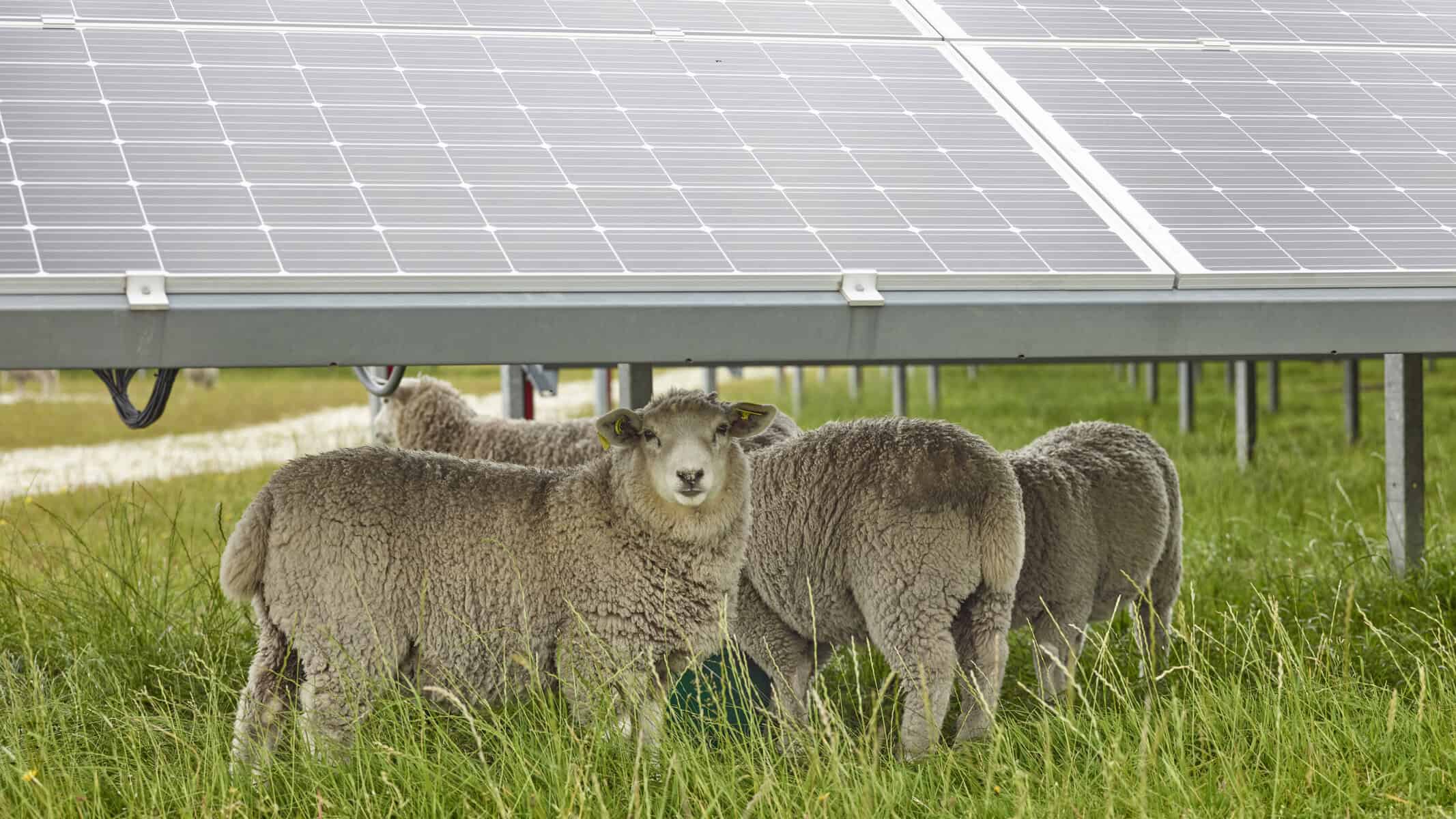
There’s also a growing practice called agrivoltaics, farming and solar coexisting on the same land. Sheep graze between and beneath panels. Wildflower meadows establish themselves. Soil, freed from intensive agriculture and pesticide use, begins to recover. The land isn’t lost; in many cases, it’s quietly improving.
“Solar farms will be turned into housing estates.”
Most UK solar farms are granted temporary planning permission, typically for 30 years, with legal conditions requiring the land to be restored to its previous use, usually farmland, at the end. The land break can actually benefit soil health and long-term agricultural potential.
“Solar farms harm wildlife.”
Evidence suggests the opposite is often true. Well-managed solar sites, with hedgerows, trees and wildflower planting, create significant habitats for pollinators and other species. Some farmers near solar installations have moved into apiary farming, taking advantage of the improved conditions for bees. The RSPB is clear that the real threat to UK wildlife is climate change, not renewable energy.
“Solar panels can’t be recycled.”
Around 98% of the materials in a solar panel, glass, silicon, aluminium, can be recycled and used in new panels or electronics manufacturing. And once a panel has been generating for around three years, it has already offset the carbon cost of its production.
“They lower house prices.”
The evidence on this is genuinely mixed and tends to be site-specific. What the data does show is that homes *with* solar panels are typically worth around 16% more than equivalent homes without, and buyers increasingly prioritise energy-efficient properties with lower running costs.
What the facts support
Solar is now one of the cheapest forms of electricity generation available. The price of panels has fallen by more than 80% in the last decade. The UK had 18.1 GW of installed solar capacity as of March 2025, up from just 0.03 GW in 2010, and the government’s target is 45–47 GW by 2030.
Energy security matters here too. The cost of depending on fossil fuel markets we don’t control has been made painfully visible in recent years. Solar generated at home, used at home, is a different kind of energy, one that isn’t exposed to the same price shocks and geopolitical risks.
This isn’t a new idea, Scotland and Wales have been doing it for years
Shared ownership of renewable energy is not a radical experiment. In Scotland and Wales, it has been government policy and established practice for over a decade.
In Scotland, Local Energy Scotland manages CARES, the Community and Renewable Energy Scheme, on behalf of the Scottish Government. CARES has supported hundreds of community energy projects, from wind turbines to solar farms, providing funding, free expert advice, and specialist support for shared ownership arrangements.
Community and locally owned renewable energy have grown from a handful of projects in the 1990s into a movement that spans the Highlands, the Borders and everywhere in between.
The Scottish Government has published Good Practice Principles for Shared Ownership and has set a target of 2 GW of community and locally owned energy capacity by 2030. A recent example: the Glenkiln solar farm on the Isle of Arran, which received planning approval in 2025, will be Scotland’s largest entirely community-owned solar farm, a 6 MW project developed by Arran Community Renewables with support from CARES and Great British Energy.
In Wales, the picture is similar.
The Welsh Government set an expectation as far back as 2020 that all new energy projects in Wales should include at least an element of local ownership. Community Energy Wales supports developers and communities to deliver shared ownership projects, has helped raise tens of millions of pounds through community share offers and bonds, and directs all profits back into local Welsh community initiatives.
The solar cooperative Egni, already the largest rooftop solar co-op in the UK, has connected solar panels to nearly 90 buildings across Wales, with surpluses reinvested into climate education and further projects.
In England, the picture is more mixed, and it’s worth being precise about the distinction between two different models.
The first model is fully community-owned solar, where a community group owns the project outright. England has genuine pioneers here: the Westmill Solar Co-operative in Oxfordshire, established in 2012, was the first community-owned solar farm in the UK. Low Carbon Hub’s Ray Valley Solar Park, also in Oxfordshire, generates enough electricity for over 6,000 homes annually and is projected to return £13 million in community benefit over its lifetime. In early 2024, the Community Energy Together partnership completed what was described as the largest transfer of community energy assets in UK history, with eight solar farms totalling 36 MW passing into community ownership across Kent, Shropshire, Devon and the Isle of Wight.
The second model, true shared ownership, where a commercial developer builds and operates the farm but offers a community group a formal equity stake, is still emerging in England, precisely because there is no policy mandate requiring it. It happens, but only when developers choose to offer it. A handful of confirmed examples exist.
Forest Gate Solar Farm in North Wiltshire, a 49.9 MW project developed by Eden Renewables, has up to 20% community ownership structured through Zero North Wiltshire and Bath and West Community Energy, making it the first subsidy-free shared ownership solar farm in Wiltshire.
Thrive Renewables’ Dunmow solar farm in Essex, operational since 2025, is offering the local community a stake of up to 10%. Eden Renewables is also progressing shared ownership at its Red Barn solar farm in North Wiltshire and Lightwood Solar Farm in Gloucestershire. And CEP itself is currently working on seven shared ownership projects with developers Thrive Renewables and Quintas Cleantech, with sites across Essex, Kent, Bedfordshire, Suffolk, South Cambridgeshire and East Hampshire, in each case with up to 10% available for local communities to buy into.
These are important and genuinely pioneering projects. But they are the exception, not the norm. England lags behind Scotland and Wales here not because communities don’t want it, but because without a mandate, it depends entirely on individual developers choosing to offer it. That needs to change, and it’s one of the things CEP is actively working to shift.
These are not pilot schemes. They are working models and they demonstrate that shared ownership is practically achievable, not just theoretically desirable.
So where does CEP come in?
It is becoming more commonplace for low-carbon developers in England to offer a community benefit fund in the areas around their project. That’s a start. But there’s a meaningful difference between a community receiving a benefit fund and a community owning a share of the asset.
Community ownership means local people have a direct stake in the revenues generated by a solar farm near them. It means lower bills for members. It means decisions about how surpluses are reinvested, in local energy projects, in community infrastructure, in further renewable capacity. It changes the relationship between a community and a development from something done to the community into something they’re part of.
That’s what CEP is working to build. Not every community will want to take on ownership, and not every site will be suitable. But where the conditions are right, shared ownership is a fundamentally better model, for the community, for local buy-in, and for the long-term success of the energy transition.
If your community is near a proposed solar development, or if you’re interested in what shared ownership could look like in practice, we’d like to hear from you. Please get in touch at kelly.dibbert@communityenergypathways.org.uk.
Community Energy Pathways supports communities to take an active role in the UK’s energy transition through shared ownership of renewable energy.